The different production processes of coal-based activated carbon generally include five process units: coal preparation, forming, carbonization, activation and finished product treatment. The coal preparation unit is mainly used to treat thecoal to a certain particle size through crushing, screening and grinding, and the finished product treatment unit is mainly used to crush, screen and package the activated materials, which are common auxiliary process units. Forming, carbonization and activation are the main process units which have great influence on the quality of activated carbon products.
Step 1 Form
The forming unit is a unique process unit of molded activated carbon such as carbon block and columnar carbon. Its functions are as follows: (1) Forming the initial appearance shape and basic macro strength of the final product; ② In the process of using more and more coal blending for activated carbon production, a variety ofcoal is promoted to form a more uniform overall structure with macro properties.
The forming of carbon briquetting is to add thecoal powder (which may be one or several kinds) into the mold of the molding machine. Under high pressure conditions, the material is pressed into block or flake particles with certain strength through the bonding force of the binding components in the coal, the attraction between the coal molecules and the thermal condensation of the binding components in the coal under high pressure conditions. Due to the large size of the block or flake particles pressed out by the block forming machine, it is also necessary to make amorphous particles that meet the size process requirements by crushing and screening (large pieces return to crushing, and the material under the screen returns to the block press).
The molding unit of columnar activated carbon includes kneading, extruding and air drying steps. Kneading has a great impact on the strength, appearance and yield of the final product of the columnar activated carbon. The process is to fully mix and stir one or several pulverized coal with a certain amount of binder (the most common is coal tar) and water at a certain temperature. The pulverized coal produces interfacial chemical condensation in the presence of binder and water to form paste materials, which has the plasticity of extrusion deformation and is easy Shape and improve product strength. The extrusion process is to knead the good coal paste through a certain specification mold under high pressure, and the coal paste is complicated.
Step 2 Carbonization
The carbonization unit is actually the process of low temperature carbonization of raw materials, in which the low molecular substances in the raw materials are first volatilized by gradually heating up in a certain low temperature range and under the condition of air isolation, and then the coal and coal tar pitch are decomposed and solidified. A series of complex physical and chemical changes will occur in the whole carbonization process, in which the physical changes are mainly dehydration, degassing and drying process, and the chemical changes are mainly thermal decomposition and thermal condensation. In that course of thermal decomposition and thermal polycondensation reaction, coal gas and coal tar precipitate from the material, forming a structure with basic graphite crystallite, which are arranged irregularly, and the gap between crystallites is the initial pore of activated carbon. Therefore, the purpose of carbonization is to make the material form the secondary pore structure which is easy to be activated and give it the mechanical strength which can endure the activation.
Step 3 Activate
The material has basic pore structure in the carbonization unit. The activation unit is to make the carbonized material have developed pore structure and huge specific surface area through technological measures under the premise of maintaining a certain strength of the material, so as to achieve the technical performance required by the activated carbon. Activation unit is the most critical process in the production of coal-based activated carbon, which directly affects the performance, cost and quality of the finished products. Activation is also the core process in the production of activated carbon, which is complicated and expensive. According to the classification of activation methods, the production methods of activated carbon are divided into three types at present, namely gas activation method, chemical activation method and chemical physical activation method. The gas activation method is the most common one in the production of coal-based activated carbon in China.
The activation process belongs to the multiphase reaction of gas and solid system, including physical diffusion and chemical reaction. The process of gas activation is the process of oxidizing and reducing carbon (C) with activating gas, corroding the surface of carbonized material, removing tar and uncarbonized material at the same time, and developing the fine pore structure of carbonized material.
The process of opening the originally blocked pores of the carbonized material, enlarging the original pores and burning out the pore wall, and forming new pores through selective activation of some structures. The formation of pores is closely related to the degree of oxidation of c. In a certain range of activation and burning rate, the deeper the gasification reaction between activated gas and carbonized material, the larger the specific surface area, the more developed the pores and the better the adsorption performance of activated carbon.
The present research shows that the activation reaction can achieve the purpose of pore formation through three stages: opening the original closed pores, enlarging the original pores and forming new pores. With the progress of the activation reaction, the pores expand continuously, and the pore walls between adjacent pores are completely burned out to form larger pores, which leads to the increase of the pore volume of mesopores and macropores. As a result, the porous structure of macroporous, mesoporous and microporous is formed, and the specific surface area of the activated carbon is developed.
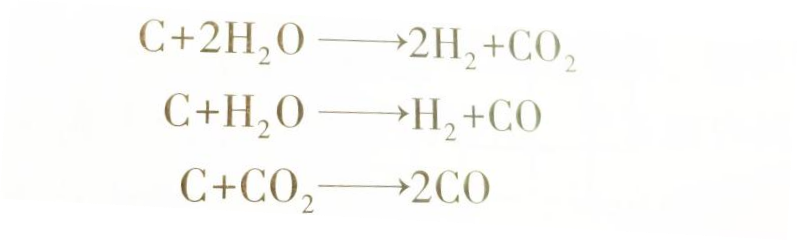
The basic principle of gas activation method is to use steam, flue gas (main component is CO,) or an oxygen-containing gas such as a mixture thereof as an activator, which is activated by a redox reaction in contact with C at a high temperature to generate CO, CO, H, and other hydrocarbon gases. The purpose of forming pores in the carbon particles is achieved by the gasification reaction (loss on ignition) of C. The main chemical reaction formula is:
The main process conditions that need to be controlled for the activation unit include activation temperature, activation time, flow rate and temperature of the activator, feeding rate, and oxygen content in the activation furnace.